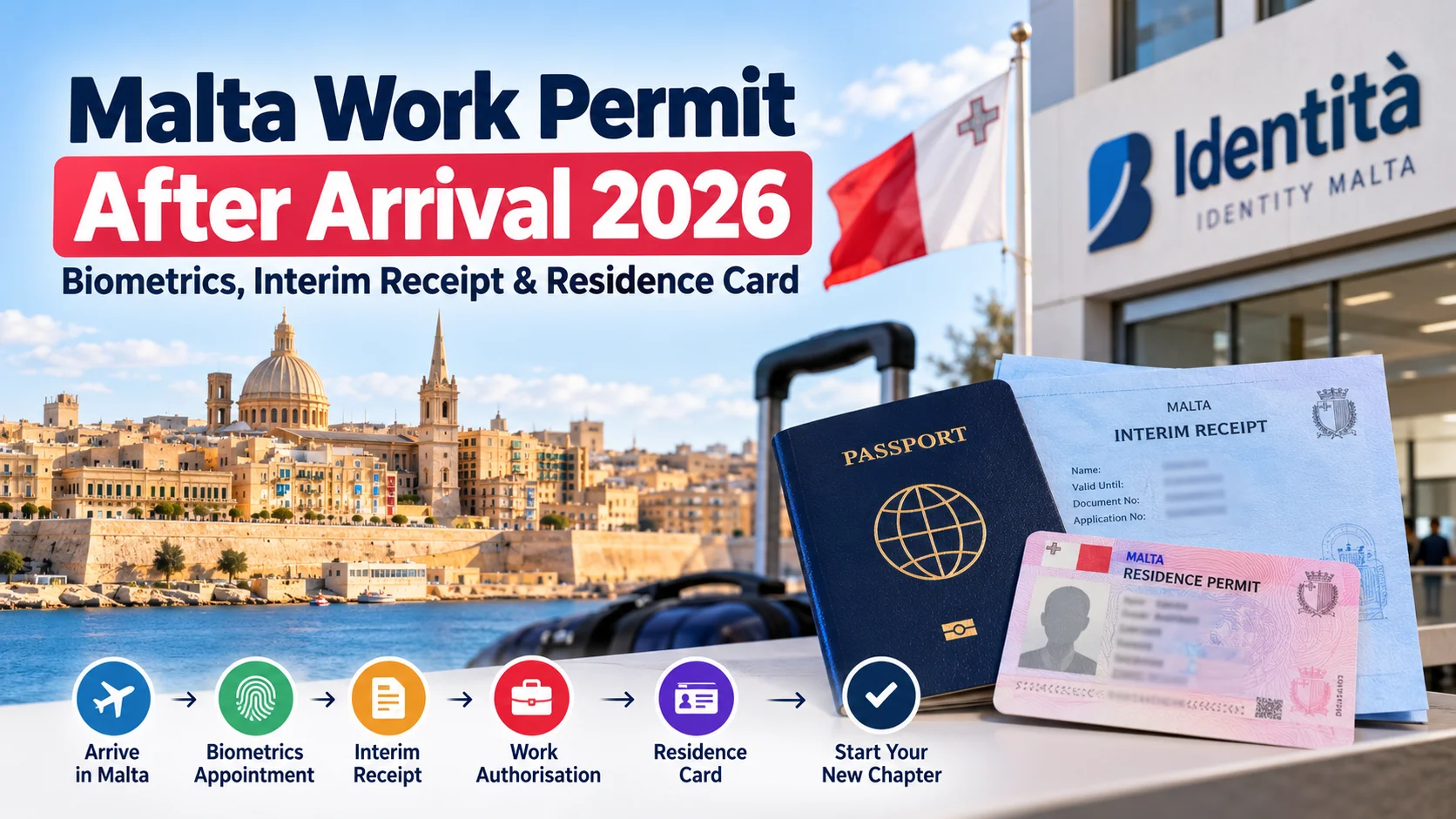
The Malta work permit after arrival 2026 process includes several important steps for non-EU workers. After arriving in Malta, you may still need to complete biometrics, present original documents, receive an Interim Receipt, obtain temporary authorisation to work and collect your residence card.
This guide explains what happens after arriving in Malta with a work visa or Approval in Principle, including the documents you may need and the common mistakes to avoid.
For many third-country nationals (TCNs), there are still several important steps to complete after arriving in Malta. These may include attending a biometrics appointment, presenting original documents, receiving an Interim Receipt, obtaining temporary authorisation to work, and eventually collecting your Maltese residence card.
This guide explains the Malta work permit process after arrival in 2026 and what non-EU workers should expect during each stage.
Malta Work Permit After Arrival 2026: What Happens Next?
If you applied for a Malta Single Permit while outside Malta, you will normally have already gone through several stages before travelling.
The general process may look like this:
Employer submits Single Permit application → Application processing → Approval in Principle → Entry visa if required → Travel to Malta → Biometrics → Interim Receipt → Residence card production → Residence card collection
The exact process can vary depending on your nationality, type of permit and individual circumstances.
It is important to follow the instructions provided by Identità because your Approval in Principle letter and other official correspondence may contain requirements specific to your application.
1. Check Your Approval in Principle Letter
The Approval in Principle, commonly known as the AIP letter, is one of the most important documents in the Malta work permit process.
Receiving an AIP generally means that your application has reached the stage where you can proceed with the next required steps.
For applicants outside Malta, this may include applying for an entry visa where required and travelling to Malta to complete the remaining residence permit formalities.
However, you should not assume that the AIP itself automatically gives you permission to start working.
Read the entire letter carefully and follow the instructions provided for your particular application.
It is a good idea to keep both printed and digital copies of your AIP.
2. Attend Your Biometrics Appointment
After arriving in Malta, one of the important steps is completing your biometrics.
Applicants are normally required to attend the relevant Identità office personally.
During this stage, biometric information required for the residence document is collected.
You should carefully check your AIP letter or biometric appointment instructions before attending because they will tell you which documents you need to bring.
Do not rely only on a checklist from a friend or another worker. Immigration cases can have different documentation requirements.
3. What Documents Should You Bring?
The exact documents required can depend on your application.
However, applicants should generally be prepared to bring their original passport and the documents specifically requested by Identità.
Depending on the case, these may include documents connected with:
- Your passport and identity
- Employment
- Accommodation in Malta
- Health insurance
- Your Single Permit application
- Approval in Principle
- Other supporting documents previously submitted online
You may also be asked to bring original versions or copies of documents that were uploaded during the online application.
Check your appointment instructions carefully before leaving home.
If required documents are missing, your biometrics process could be delayed and you may need another appointment.
4. What Happens During Biometrics?
During the biometrics appointment, Identità collects information needed for your residence document.
This normally includes your photograph and fingerprints.
Applicants should ensure that their face is clearly visible for the photograph.
Avoid anything that could unnecessarily obscure your face. If you wear a religious head covering, the relevant facial features must still remain visible according to the applicable requirements.
It is also sensible to dress appropriately for the official photograph.
The officer may also check the original documents connected with your application.
5. What Is the Malta Interim Receipt?
After successfully completing the required biometrics and document checks, you may receive an Interim Receipt.
This is an important temporary document issued while your residence card is being finalised.
The Interim Receipt can provide evidence of your temporary legal status in Malta during this period.
It has an expiry date, so check the document carefully as soon as you receive it.
Interim Receipts are generally issued for a limited period and may need to be extended if your residence card has not been finalised before the receipt expires.
Keep the original Interim Receipt in a safe place.
6. Can You Start Working With an Interim Receipt?
This is one of the most important things for new non-EU workers to understand.
Having an Interim Receipt does not automatically mean that you are authorised to work.
You need to check whether the document includes the appropriate Temporary Authorisation to Work.
When the required temporary work authorisation is attached or indicated on the employment-related Interim Receipt, it can allow the worker to take up employment while waiting for the physical residence card.
Therefore, do not simply assume:
“I have the Interim Receipt, so I can start working.”
Check the document carefully and make sure that you have the required authorisation before starting employment.
Your employer should also ensure that the necessary employment registration requirements have been completed.
7. Is the Interim Receipt a Travel Document?
No.
This is another important point that non-EU workers should understand.
An Interim Receipt is not a travel document.
It may confirm your temporary status while you are in Malta, but this does not mean that the document can be used like a residence card for international travel.
Leaving Malta while your residence card is still being processed can create complications depending on your passport, visa and immigration status.
If you need to travel urgently, check the applicable entry and re-entry requirements before booking flights.
Do not assume that the Interim Receipt alone will allow you to return to Malta.
8. What Happens After Biometrics?
Once your biometrics and document checks have been completed, the residence permit process continues.
Your residence document will eventually move toward production if all applicable requirements have been satisfied.
During this period, keep checking the status of your application through the appropriate official channels.
You should also monitor your email and other contact details provided during the application.
Most importantly, make sure that your registered residential address in Malta is correct.
This is important because information relating to the collection of your residence card may be sent to that address.
9. Residence Card Collection Letter
When your residence card is ready, you should receive information about collecting it.
A collection letter may be sent to your registered address in Malta.
This letter is important and should not be thrown away.
It can contain information required when collecting your residence card, including a collection PIN.
If your application status indicates that a collection letter has been issued but you have not received it after a reasonable period, contact Identità through the appropriate official channel.
10. How to Collect Your Malta Residence Card
Once you receive the collection notification, you can proceed with collecting your physical residence card according to the instructions provided.
You should normally be prepared to bring documents such as:
- Your valid passport
- Your collection letter
- Your Interim Receipt
- Your previous residence permit, if applicable
Check the current Identità instructions before visiting the collection office because requirements can change.
Once the residence card is issued to you, check the information printed on it.
Make sure that your personal details are correct and take note of the card’s expiry date.
11. What If Your Interim Receipt Is About to Expire?
Do not ignore the expiry date printed on your Interim Receipt.
If your residence card has not been issued and your Interim Receipt is approaching expiry, contact Identità before it expires.
Depending on your circumstances, the Interim Receipt may need to be extended.
Waiting until after the document has expired can create unnecessary problems.
A useful habit is to set a reminder on your phone several weeks before the expiry date so that you have enough time to take action if necessary.
12. What If You Change Your Address?
Non-EU residents should keep their registered residential information updated.
This becomes particularly important while waiting for a residence card because official correspondence may be sent to the address registered with the authorities.
If you move to another apartment or property during the process, complete the appropriate address-change procedure as soon as possible.
Do not assume that changing your address with your employer, bank, mobile provider or landlord automatically updates your immigration records.
These are separate systems.
An outdated address could result in important correspondence being sent to your previous residence.
13. What If You Lose Your Interim Receipt?
Treat your Interim Receipt as an important immigration document.
Do not carry the original unnecessarily if you do not need it.
Keep it somewhere secure and consider keeping a scanned copy or photograph for your personal records.
If you lose the original Interim Receipt, you may need to report the loss to the police and follow the procedure required by Identità.
A police report may also be required when you later collect your residence card if the original Interim Receipt has been lost.
14. Can You Change Employer After Receiving Your Permit?
A Malta Single Permit is connected to the employment conditions for which it was approved.
Receiving a residence card does not automatically give a non-EU national unrestricted permission to work for any employer in Malta.
If you want to leave your current employer and work for another company, you generally need to follow the applicable change-of-employer procedure.
Do not simply stop working for one employer and immediately start working for another because you already have a residence card.
Changing employer without following the correct procedure can affect your immigration and employment status.
15. Keep Your Passport Valid
Your passport remains one of your most important documents while living in Malta.
Check its expiry date regularly.
Do not wait until the last moment to renew it, particularly if your residence permit renewal or another immigration application is approaching.
If you receive a new passport while holding a Maltese residence permit, check whether you need to update your passport details with the relevant authorities.
Keep copies of both your old and new passport where appropriate.
16. Keep Copies of Important Documents
It is a good idea to create a secure digital folder containing copies of your important Malta documents.
This may include:
- Passport
- Visa
- Approval in Principle
- Employment contract
- Single Permit documents
- Interim Receipt
- Residence card
- Rental agreement
- Insurance documents
- Payslips
- Jobsplus-related employment records
- Important emails from Identità
Do not depend entirely on your employer or recruitment agency to keep these documents for you.
You should maintain your own records.
Common Mistakes Non-EU Workers Should Avoid
The period between arriving in Malta and receiving the residence card can be confusing, particularly for someone going through the process for the first time.
One common mistake is arriving at a biometrics appointment without all the requested documents.
Another is assuming that receiving an Approval in Principle automatically means you can begin working immediately.
Workers can also mistakenly assume that every Interim Receipt gives permission to work. The appropriate temporary work authorisation must be present where required.
Travel is another area where mistakes happen. An Interim Receipt should not be treated as a replacement for a passport, visa or residence card for international travel.
Other common problems include failing to update a residential address, losing important documents, ignoring expiry dates and starting employment with another employer without following the proper procedure.
The safest approach is simple:
Read your own official documents carefully and follow the instructions issued for your individual application.
Do not rely entirely on what happened to a friend, colleague or someone posting in a social media group.
Malta Work Permit After Arrival: Step-by-Step Timeline
For many first-time non-EU workers, the process may look something like this:
Step 1: Employer submits the Single Permit application
↓
Step 2: Application is processed
↓
Step 3: Approval in Principle is issued
↓
Step 4: Applicant obtains an entry visa if required
↓
Step 5: Applicant travels to Malta
↓
Step 6: Applicant attends biometrics and presents the required documents
↓
Step 7: Interim Receipt is issued when applicable
↓
Step 8: Temporary Authorisation to Work allows employment where applicable
↓
Step 9: Residence card is produced
↓
Step 10: Collection notification is issued
↓
Step 11: Applicant collects the physical residence card
The exact timing and individual requirements can vary.
Frequently Asked Questions
Can I start working immediately after arriving in Malta?
Not necessarily.
Simply arriving in Malta or possessing an Approval in Principle does not automatically mean that you can start working.
You should confirm that you have received the appropriate authorisation permitting you to take up employment.
Is the Approval in Principle my Malta residence permit?
No.
The Approval in Principle is an important stage of the application process, but it is not the physical residence card.
Further steps may still be required after the AIP is issued.
Is the Interim Receipt the same as a residence card?
No.
The Interim Receipt is a temporary document used during the residence permit process.
The physical residence card is issued separately.
How long is an Interim Receipt valid?
The document is issued for a limited period.
Always check the exact expiry date printed on your own Interim Receipt rather than relying on someone else’s experience.
If it is approaching expiry and your residence card has not been finalised, contact Identità.
Can I travel using only my Interim Receipt?
No.
The Interim Receipt should not be treated as a travel document.
Before leaving Malta while your residence card is still being processed, check your visa, passport and re-entry requirements carefully.
Can I work with an Interim Receipt?
Only where you have the appropriate authorisation to work.
Check whether your employment-related Interim Receipt contains the required Temporary Authorisation to Work.
What happens when my residence card is ready?
You should receive the relevant collection information.
Follow the instructions provided and bring the required documents when collecting your residence card.
What if I move to another apartment while waiting for my card?
Update your registered address using the appropriate procedure.
This is particularly important because official correspondence may be sent to your registered Maltese address.
Can my employer keep my passport or residence card?
Your passport and residence documents are important personal documents. Keep control of your originals and provide them temporarily for legitimate administrative purposes only when necessary.
Maintain your own copies of all important employment and immigration documents.
Final Thoughts
Arriving in Malta is an exciting milestone for a non-EU worker, but it is important to understand that your immigration process may not be completely finished when you leave the airport.
Biometrics, document verification, the Interim Receipt, temporary work authorisation and residence card collection can all form part of the process after arrival.
Keep your documents organised, monitor expiry dates and maintain an accurate registered address.
Most importantly, understand the difference between the various documents you receive.
An Approval in Principle is not the same as a residence card.
An Interim Receipt is not automatically permission to work.
And an Interim Receipt is not a travel document.
Following the correct procedure from the beginning can help you avoid unnecessary delays and problems while starting your new life and employment in Malta.
Last updated: September 2026
Disclaimer: This article is provided for general informational purposes only and does not constitute legal or immigration advice. Immigration procedures and requirements may change. Always check the latest instructions from Identità and the relevant Maltese authorities for your individual circumstances.