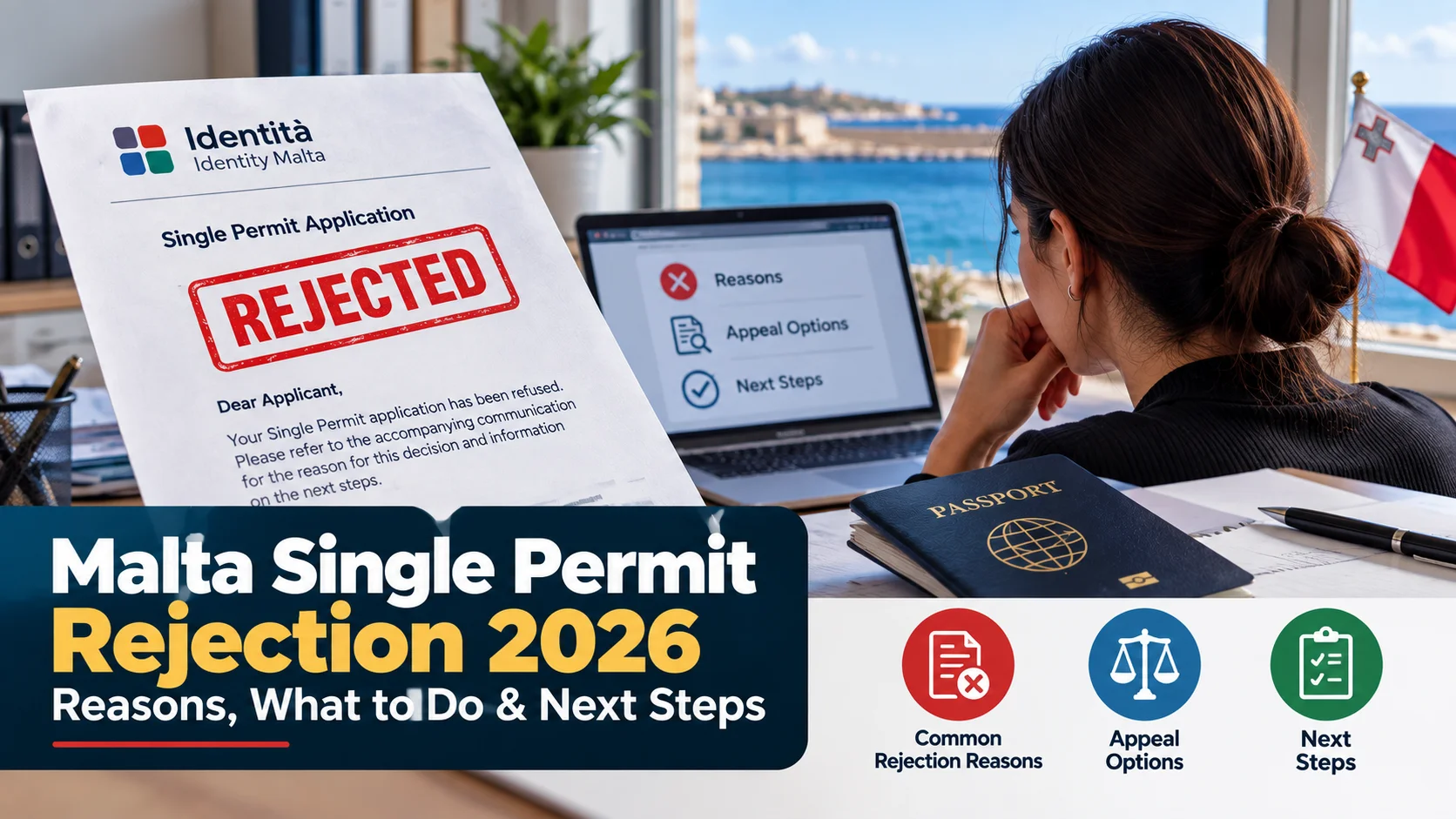
A Malta Single Permit rejection 2026 decision can create serious uncertainty for a non-EU worker, especially after the employer has submitted documents and the applicant has waited for the authorities to process the application.
However, you should not submit another application immediately. Instead, first identify why the authorities rejected the application. Then check the refusal communication, speak with your employer and determine which options remain available.
Depending on your circumstances, you may need to correct a problem, submit a new application, consider an appeal, or seek professional immigration advice.
This guide explains common Malta Single Permit rejection reasons, what a rejection means, possible appeal options and the practical steps you should take next.
Important: Every immigration case is different. Therefore, always follow the instructions and deadlines in your official refusal communication.
What Does a Malta Single Permit Rejection Mean?
The Malta Single Permit allows eligible third-country nationals to live and work in Malta under specified employment conditions.
The permit combines residence and employment authorisation into one procedure.
When your application receives a Rejected status, the authorities have not approved that particular application. Therefore, you should check the formal refusal communication rather than waiting for the application to continue processing.
The refusal communication should help you understand why the application failed and what options may be available next.
Who Assesses a Malta Single Permit Application?
Several Maltese authorities can contribute to the Single Permit assessment.
Identità manages the residence and Single Permit process. Meanwhile, Jobsplus deals with relevant employment-related assessments. Other authorities may also carry out checks when necessary.
Consequently, a rejection does not always result from a problem with the employee’s personal documents.
For example, the issue may involve:
- applicant eligibility;
- employment conditions;
- the prospective employer;
- missing or invalid documents;
- labour-market requirements;
- due-diligence checks; or
- requirements connected to a particular occupation.
Therefore, identify the exact reason before deciding what to do next.
Common Malta Single Permit Rejection 2026 Reasons
There is no single reason for every Malta Single Permit rejection 2026 decision.
Instead, the reason depends on the applicant, employer, job and supporting documentation.
Below are several issues that can affect a Single Permit application.
1. Missing or Invalid Documents
First, check whether the application contained all required documents.
Missing, expired, incomplete or inconsistent documents can create problems during processing.
Depending on the application, the required documents may include:
- passport copies;
- employment contract;
- CV;
- health insurance;
- accommodation documents;
- employment declarations;
- professional certificates;
- qualifications; and
- occupation-specific licences or approvals.
In addition, Identità may ask for further evidence depending on the individual case.
Therefore, always check the latest official checklist for your application type.
2. Passport Problems
Your passport plays a central role in the Single Permit application.
Before applying, check its validity and make sure you provide all required passport pages.
If you renew your passport while an application remains under consideration, follow Identità’s instructions for updating the relevant information.
Otherwise, passport discrepancies may delay the application or create additional complications.
3. Employment Information Does Not Match
Next, compare all employment documents carefully.
Information about the job should remain consistent throughout the application.
For example, check the:
- job title;
- salary;
- working hours;
- employment conditions;
- employment contract;
- position description; and
- relevant Jobsplus information.
Even a seemingly small discrepancy may require clarification.
Therefore, the employer should review the employment information before submitting the application.
4. Salary or Employment Conditions
The proposed employment must comply with the applicable Maltese requirements.
For this reason, problems involving salary, working conditions or employment terms can affect the assessment.
The authorities may examine whether the employment conditions correspond with the job and applicable rules.
Moreover, applicants should not rely only on verbal promises from an employer. The authorities assess the information and documents submitted with the application.
5. Employer-Related Problems
The employer plays a major role in the Single Permit process.
In most cases, the prospective employer submits the application for the third-country national.
As a result, employer-related problems can also affect the employee’s application.
For example, relevant issues may concern employer compliance, licensing, recruitment requirements or the employer’s eligibility to recruit third-country nationals.
Therefore, an applicant may provide correct personal documents but still face problems because of an employer-related issue.
6. Labour-Market Requirements
Jobsplus carries out relevant employment-related assessments during the Single Permit process.
Depending on the application, the employer may need to satisfy current labour-market requirements before recruiting a third-country national.
For example, certain applications can require vacancy advertising through the relevant channels for a specified period.
Consequently, employers should check the current Jobsplus and Identità requirements before submitting an application.
7. Employer Workforce or Recruitment Issues
Malta’s labour-migration rules also place obligations on employers that recruit third-country nationals.
Therefore, an employer’s recruitment practices, workforce circumstances or compliance history may affect certain applications.
Applicants should remember that the authorities do not assess only the employee. They may also consider relevant information concerning the prospective employer.
8. Health Insurance Problems
Health insurance requirements can also apply during the Single Permit process.
Therefore, check whether the insurance policy meets the requirements for your particular application.
For example, an expired policy or unsuitable coverage can create problems.
Additionally, do not automatically assume that ordinary travel insurance satisfies residence-permit health insurance requirements.
Always check the current official checklist before purchasing or submitting insurance documentation.
9. Accommodation Documentation Problems
Accommodation documentation may form another part of the Single Permit process.
Depending on your circumstances, you may need to provide evidence concerning your accommodation in Malta.
Therefore, make sure that leases and related documents remain valid and contain accurate information.
If you change your residential address, follow the appropriate procedure for updating it.
You can also read our guide on changing your address in Malta as a TCN for more information.
10. Missing Qualifications or Professional Requirements
Some jobs require additional qualifications, licences or certificates.
For example, an occupation may require:
- recognised qualifications;
- professional licences;
- a Skills Pass;
- food-handling certification;
- security-related authorisation; or
- other occupation-specific documentation.
Requirements vary according to the job.
Therefore, confirm the requirements before your employer submits the Single Permit application.
11. Due-Diligence or Security Concerns
The authorities can conduct due-diligence and other relevant checks during the Single Permit process.
Consequently, serious immigration, legal or security concerns can affect the outcome.
These cases may require more careful attention than an ordinary missing-document problem.
Therefore, consider obtaining qualified professional advice if your refusal involves a serious immigration, legal or security matter.
12. The Applicant Does Not Meet the Eligibility Requirements
Finally, not every third-country national qualifies for the Single Permit procedure.
Applicants must satisfy the eligibility requirements that apply to their circumstances.
Therefore, confirm that the Single Permit is the correct immigration route before starting the application.
If you are unfamiliar with the process, read our Malta Single Permit 2026 guide for non-EU workers before submitting an application.
Malta Single Permit Rejection 2026: What Should You Do First?
If you receive a Malta Single Permit rejection 2026 decision, avoid immediately submitting another application.
Instead, follow these steps.
Step 1: Read the Refusal Communication Carefully
First, read the entire decision.
Do not focus only on the word Rejected.
Instead, look for:
- the reason for the decision;
- the decision date;
- information about appeal rights;
- any applicable appeal deadline;
- instructions concerning your immigration status; and
- information about your next steps.
Most importantly, save a copy of the communication.
Step 2: Contact Your Employer
Next, speak with your employer or the authorised company representative who handled the application.
Because employers submit most Single Permit applications, they may have relevant information through the Single Permit Online Portal.
Additionally, the employer should check whether an employment document or employer-related issue contributed to the refusal.
Step 3: Identify the Actual Problem
After reviewing the refusal, determine whether you can correct the underlying problem.
For example, some cases may involve documentation errors or inconsistent information.
However, other cases may involve:
- applicant eligibility;
- employer compliance;
- labour-market requirements;
- due diligence; or
- another substantive issue.
These problems require different responses.
Therefore, understand the cause before spending money on another application.
Can You Appeal a Malta Single Permit Rejection?
Depending on the decision, you may have a right to appeal.
Identità provides information concerning appeals against immigration decisions, while the Immigration Appeals Board handles relevant appeals.
However, immigration appeal deadlines can be short.
Therefore, read the refusal communication immediately after receiving it and follow the specific deadline stated in your decision.
Do not assume that you have several weeks or months to act.
For current procedures, check the official Identità information before taking action.
How Do You Appeal a Malta Single Permit Rejection?
If the decision provides an appeal route, follow the instructions in the refusal communication.
Generally, an appeal should address the actual reason for refusal rather than simply state that you disagree with the decision.
Furthermore, you may need supporting evidence depending on the circumstances.
For example, relevant evidence could clarify an error, document an important fact or address a specific issue raised in the refusal.
Because immigration appeals can have legal consequences and strict deadlines, consider professional advice when the case is complicated.
Does an Appeal Allow You to Stay in Malta?
Do not assume that an appeal automatically gives you permission to remain in Malta.
Your immigration position depends on your existing legal status and the circumstances surrounding the application.
Therefore, if you are already in Malta when you receive a rejection, check your current immigration status immediately.
This becomes particularly important when your existing visa or residence permit is close to expiry.
If you cannot determine your status from the official documents, contact the relevant authority or seek qualified professional advice.
Can You Continue Working After a Single Permit Rejection?
A Single Permit application does not automatically provide unlimited permission to work.
Likewise, filing an appeal does not necessarily mean that you can continue employment.
Instead, your ability to work depends on the valid authorisation that applies to your circumstances.
Therefore, verify your current employment authorisation before continuing to work after a rejection.
If you already hold a permit and need to extend it, our Malta Single Permit Renewal 2026 guide explains the renewal process separately.
Can You Apply Again After a Malta Single Permit Rejection?
In some circumstances, you may be able to submit a new application.
However, first determine why the previous application failed.
For example, if the refusal resulted from a correctable issue, a future application may address that problem.
Nevertheless, submitting exactly the same information again without correcting the underlying issue may lead to the same difficulty.
Before submitting another application, the employer and applicant should check:
- why the previous application failed;
- whether they can correct the problem;
- whether the applicant remains eligible;
- whether the employer meets the current requirements; and
- whether a new application is the correct next step.
What If You Need to Change Employer?
A rejected application can sometimes coincide with a change in employment circumstances.
For example, the original employer may no longer wish to continue with the recruitment process.
However, you should not simply start working for another company.
Instead, check which immigration and employment procedure applies to your situation.
Our Changing Employers or Jobs in Malta guide explains this subject in more detail.
What If Your Employer Withdraws the Application?
A withdrawn application differs from a rejected application.
For example, an employer may withdraw an application before the authorities complete the process.
After withdrawal, that application no longer continues normally.
If another employer wants to employ you, you may need a new application or the applicable change-of-employer procedure.
Therefore, check your legal status before beginning work for another employer.
Rejected vs Withdrawn vs Revoked
These three terms have different meanings.
Rejected means the authorities did not approve the application.
Withdrawn generally means the applicant or employer ended the application before completion.
Revoked generally concerns an authorisation or permit that the authorities subsequently cancelled or withdrew.
Because the consequences differ, always read the official communication connected to your individual case.
Will You Get the Single Permit Application Fee Back?
Do not assume that a rejection entitles you to a refund.
Identità’s rules generally provide that applicable application fees are non-refundable in cases such as refusal, withdrawal, revocation or inadmissibility.
Therefore, applicants and employers should carefully check eligibility and documentation before submitting an application.
How to Reduce the Risk of Malta Single Permit Rejection
No applicant can guarantee approval.
Nevertheless, careful preparation can reduce avoidable mistakes.
Before submitting the application:
- check the latest Identità checklist;
- verify passport validity;
- prepare valid supporting documents;
- review the employment contract;
- make sure the job title and salary information match;
- check health insurance requirements;
- prepare the required accommodation documents;
- obtain relevant qualifications or licences;
- check occupation-specific requirements;
- confirm that the employer meets the applicable rules;
- review the complete application carefully; and
- respond promptly to requests for additional information.
Furthermore, keep copies of everything you submit.
Never Submit False or Misleading Information
Never alter a document or provide false information to improve the chances of approval.
False or misleading information can create much more serious consequences than an ordinary documentation mistake.
Instead, if you discover incorrect information in an application, contact the employer or relevant authority and ask how to correct it properly.
Keep Copies of Your Documents
Good record-keeping can make immigration problems easier to manage.
Therefore, keep copies of:
- passport documents;
- application confirmations;
- employment contracts;
- payment receipts;
- insurance documents;
- accommodation documents;
- employer correspondence;
- Identità communications;
- Approval in Principle documents, where applicable;
- refusal communications; and
- appeal documents.
Additionally, keep important documents together so that you can access them quickly if the authorities request information.
Malta Single Permit Rejection 2026 Checklist
After receiving a rejection, work through this checklist:
- Read the complete refusal communication.
- Identify the exact reason.
- Record the date you received the decision.
- Check whether you have an appeal right.
- Check the appeal deadline immediately.
- Contact your employer.
- Review information available through the Single Permit Online Portal.
- Confirm your current immigration status.
- Verify your current permission to work.
- Check for missing, expired or inconsistent documents.
- Determine whether the problem concerns the employer.
- Avoid submitting another application without addressing the problem.
- Keep all correspondence and documents.
- Seek professional advice when necessary.
Frequently Asked Questions
What does “Rejected” mean on a Malta Single Permit application?
A rejected status means the authorities did not approve that particular application. Therefore, check the official refusal communication for the reason and any available next steps.
Can I appeal a Malta Single Permit rejection?
Depending on the decision, an appeal may be available. Therefore, read the refusal communication immediately and check the applicable deadline.
How long do I have to appeal?
The applicable deadline depends on the decision and current procedure. Because immigration appeal periods can be short, follow the deadline stated in your official refusal communication rather than relying on general information online.
Can my employer appeal for me?
The appropriate procedure depends on the decision and individual circumstances. Therefore, check the refusal communication and obtain guidance where necessary.
Can I apply again after rejection?
A new application may be possible in some circumstances. However, identify and address the reason for the previous refusal before submitting another application.
Will Identità refund my application fee after rejection?
Generally, applicants should not expect a refund simply because an application failed. Check the current Identità fee and refund rules that apply to your application.
Can I work while appealing?
Do not assume that an appeal provides work authorisation. Instead, check the valid employment and immigration authorisation that applies to your circumstances.
Can I remain in Malta after a rejection?
Your ability to remain depends on your existing immigration status and circumstances. Therefore, check your refusal communication and current permit or visa immediately.
Can my employer cause my Single Permit application to fail?
Employer-related issues can affect the application because the Single Permit procedure includes employment-related assessments. Therefore, both the applicant and employer should review the reason for refusal.
Is rejection the same as revocation?
No. A rejection concerns an application that did not receive approval. In contrast, revocation generally concerns an authorisation or permit that the authorities later cancelled or withdrew.
Final Thoughts
A Malta Single Permit rejection 2026 decision requires quick and careful attention.
First, read the complete refusal communication. Next, identify the reason for the decision and speak with your employer. Then verify your current immigration and employment status.
If an appeal option exists, pay close attention to the deadline. Alternatively, if a correctable problem caused the rejection, determine whether a new application is appropriate before submitting anything else.
Above all, do not assume that a pending appeal, previous employment or rejected application automatically allows you to remain or work in Malta.
For complicated cases involving previous refusals, legal status, security concerns or an appeal, consider obtaining advice from an appropriately qualified Maltese immigration professional.
Disclaimer
This article provides general information about the Malta Single Permit process. It does not provide legal or immigration advice.
Rules, procedures, fees and document requirements can change. Therefore, always check the latest official information from Identità and Jobsplus and follow the instructions in your individual refusal decision.
Last updated: October 2026