Moving to a new flat in Malta may feel simple once you have collected the keys and moved your belongings.
For a third-country national, however, there is one more important job: updating the address connected to your Maltese residence permit.
This is not something you should leave until your next renewal.
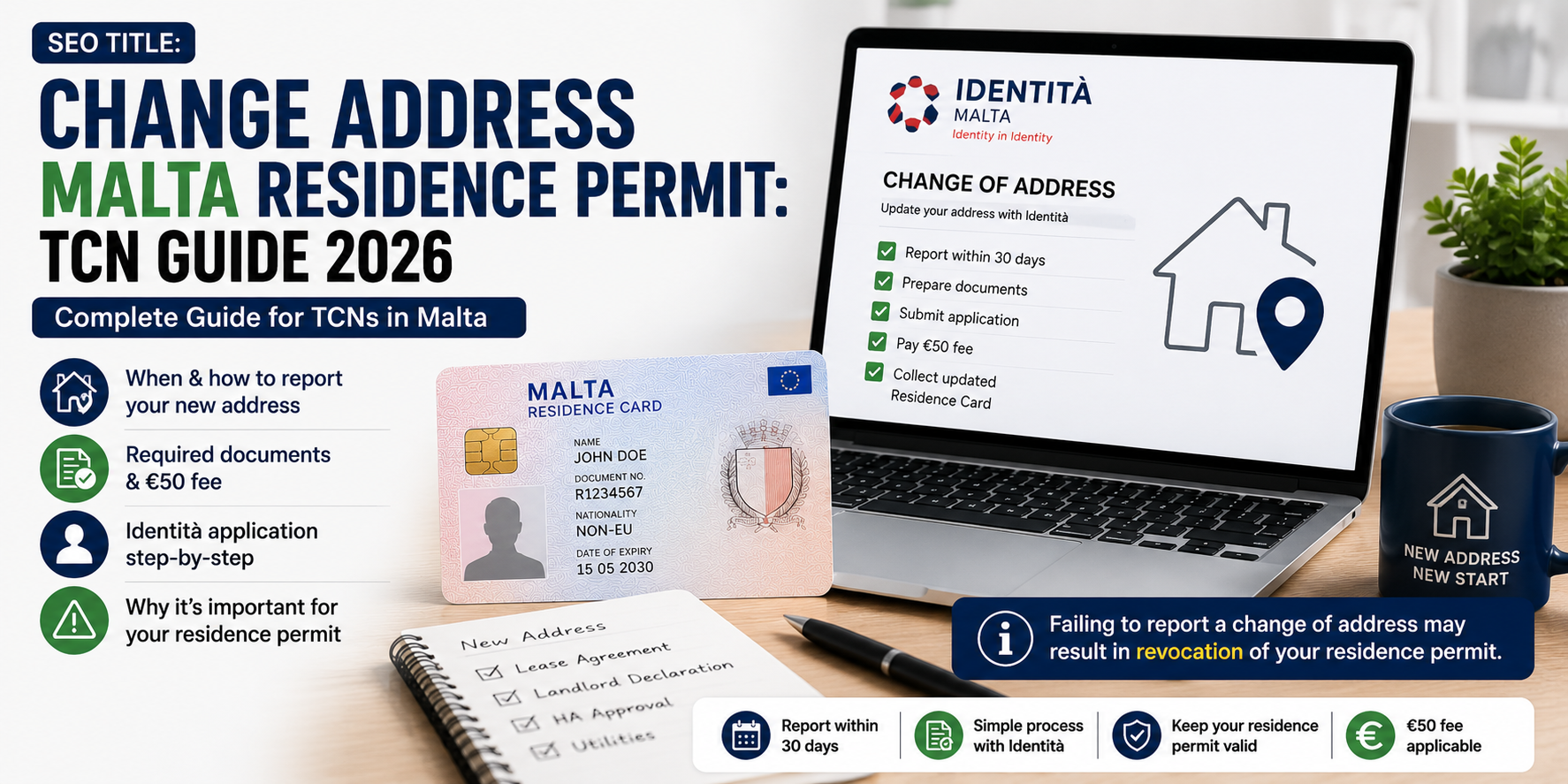
Identità states that Non-EU nationals must register a change of address with its Expatriates Unit. It also warns that failing to notify the authority may result in revocation of the residence permit.
The process can be confusing because changing your address involves more than showing a new rental contract.
Depending on your residence category, you may need your residence card, passport, Housing Authority approval, a special Lease Agreement Attestation Form and, in some cases, an architect’s attestation. Family members may also need to wait until their sponsor has updated the sponsor’s address first.
This guide explains the process in simple English.
Quick answer: To change your registered address in Malta as a TCN, you normally need your residence card, passport, new lease or property purchase agreement, Housing Authority approval and Lease Agreement Attestation Form. Some family and Long-Term Residence permit holders also need an architect’s attestation. The current standard Non-EU change-of-address fee published by Identità is €50.
What does TCN mean in Malta?
TCN means third-country national.
In the EU immigration context, this generally means a citizen of a country outside the European Union. The European Commission also describes non-EU citizens as third-country nationals.
In Malta, Identità’s Expatriates Unit is responsible for issuing residence permits to third-country nationals.
This article mainly concerns people holding Maltese residence permits as Non-EU nationals, including workers, students, family members and some long-term residents.
British Withdrawal Agreement beneficiaries, EU citizens, Maltese citizens and people under certain special residence programmes can have different processes or fees, so they should follow the guidance for their own category. For example, Identità’s current consolidated checklist lists a €50 address-change fee for standard Non-EU nationals but no fee for Exempt and Brexit address changes.
Do you really need to change your Malta residence-card address?
Yes.
Identità’s wording is clear: Non-EU nationals must register any change of address with the Expatriates Unit.
This matters even when:
- you are still working for the same employer;
- your Single Permit has not expired;
- you are only moving to another flat in the same town;
- your landlord says mail can continue going to your old address;
- your residence-card renewal is several months away.
An address change is about keeping your residence records correct. It does not become unnecessary just because the rest of your situation has stayed the same. Identità specifically warns that failure to notify an address change may result in permit revocation.
There is another practical reason not to delay.
Property owners have a formal process for telling Identità that a foreign person is using their address without authorisation. For a non-Maltese national, the owner can contact Identità’s Compliance Unit and submit a De-Registration Form with supporting documents.
So imagine you move from Msida to Birkirkara.
You leave your old apartment, return the keys and start living at the new property. But three months later, your residence card still shows the Msida address.
Your previous landlord receives official correspondence in your name and tells Identità that you no longer live there.
That can create an unnecessary problem that could have been avoided by updating your address promptly.
Identità’s current address-change page does not publish a specific number of days within which an ordinary address change must be completed. It nevertheless says the change must be registered, so the sensible approach is to begin as soon as the new accommodation documents are ready.
What documents do TCNs need for a change of address?
According to Identità’s latest consolidated Non-EU checklist, the standard change-of-address file can include:
| Document | Why it matters |
|---|---|
| Changes to Application Form | Records the requested change |
| Existing residence card plus front-and-back copy | Identifies your current residence document |
| Valid passport plus biometric-page copy | Confirms your identity |
| Valid lease or property purchase agreement | Shows the new accommodation |
| Housing Authority approval email | Confirms the rental registration, where applicable |
| Lease Agreement Attestation Form | Additional verification for rented accommodation |
| Architect Attestation | Required for certain Long-Term Residence and family-member cases |
| Sponsor’s updated document | Required for applicable family-member applications |
Identità states that Housing Authority approval and the Lease Agreement Attestation Form are not required in the standard checklist where the applicant owns the Malta property. The Architect Attestation exception also applies where the relevant applicant owns the property.
There may be category-specific requirements, so always compare your documents with the checklist generated or published for your particular residence basis before submission. Identità expressly notes that supporting documents can vary depending on the requested change.
Your new lease agreement
Your lease is one of the central documents.
Make sure the details are correct before using it for your residence application.
Check your:
- full name;
- new property address;
- lease dates;
- landlord details;
- signatures.
Employment-permit checklists published by Identità also emphasise that the applicant should be properly identified on the property lease or purchase agreement and that the lease should show its start and end dates.
Do not rely on “the landlord knows I live there”.
Your application is based on documents, not an informal understanding.
Housing Authority approval
This is one of the areas that causes the most confusion.
A signed lease agreement and Housing Authority approval are not the same document.
Malta’s Housing Authority operates the private residential lease registration system, and its official services describe private residential leases as subject to registration under the relevant rental framework.
Identità’s change-of-address checklist separately requests:
- the valid lease agreement; and
- the Housing Authority approval email.
That means a TCN should not assume, “I signed the contract yesterday, so everything is ready for Identità.”
First check that the rental registration process has been completed and that the required approval is available.
The Housing Authority’s current rent-registration notice says lease submissions should be made within 30 days from the lease start date, with the standard €10 registration fee for contracts submitted within that period; it also says a €120 late-registration fee may apply from 1 September 2025 to contracts submitted more than 30 days after commencement. These are landlord/rental-registration charges, not the Identità €50 residence-card address-change fee.
Lease Agreement Attestation Form
This is the document many older Malta guides do not explain properly.
Identità introduced additional verification of lease agreements for TCN residence documentation in September 2024. Its current guidance says third-country national applicants must provide the Lease Agreement Attestation Form where applicable.
For someone changing a registered address, Identità’s FAQ is especially clear: residence-permit holders changing their registered address must inform the agency and provide the new lease, new Housing Authority approval and corresponding Lease Agreement Attestation Form.
The form involves the landlord and must be attested by a:
- lawyer;
- notary; or
- legal procurator.
This means you should discuss the requirement with your landlord early.
Do not wait until the evening before your Identità submission and then discover that the required form has not been prepared.
Architect Attestation for certain applicants
Not every TCN changing address needs an Architect Attestation.
According to Identità’s latest consolidated checklist, the requirement applies specifically to Long-Term Residence holders and family-member residence-permit holders in the relevant rented-property situation. It is not required there when the applicant owns the Malta property.
This is an important detail because older FAQs can use broader wording. When official pages are not perfectly aligned, use the newest checklist for your category and ask Identità to confirm anything unclear before paying for professional documentation.
How to change your address in Malta step by step
Here is the practical process I would recommend following.
Check which residence permit you actually hold
Before uploading anything, look at your residence category.
A TCN employed under a Single Permit is not necessarily using the same administrative route as a student or family member.
Identità’s dedicated Non-EU address-change page states that an address change can be submitted online through the Single Permit portal.
For Non-EU residence permits based on something other than employment, Identità’s dedicated page directs applicants to the Expatriates Unit Portal. Its FAQ says applicants can use e-ID or the portal’s alternative login feature.
So do not follow instructions from a colleague simply because both of you are TCNs.
Your colleague may hold a student permit while you hold a Single Permit.
Finalise the new accommodation
Sign the new lease or complete the property purchase documentation.
Before moving to the next step, check that the address and your personal details are accurate.
A spelling difference between your passport name and lease can create unnecessary questions.
If several people share the accommodation, make sure your own legal occupancy is properly reflected in the documentation required for your permit category.
Make sure the lease is registered
For rented private residential accommodation, coordinate with the landlord so the lease registration is completed through the Housing Authority process.
Wait until you have the Housing Authority approval required by Identità rather than treating the signed contract as the final document.
Keep the approval email or document safely.
You may need it again for later residence-related administration.
Arrange the lease attestation
Ask the landlord to complete the relevant Lease Agreement Attestation Form and arrange the required professional attestation.
Identità states that the form is signed in connection with the landlord/lessor and attested by a lawyer, notary or legal procurator.
Make sure the attested document corresponds to the same property and lease you are submitting.
Check whether you need an architect’s attestation
This is particularly important if your residence status is:
- Long-Term Residence; or
- a family-member residence permit.
The current Identità checklist specifically lists the Architect Attestation for those categories where applicable.
If you are unsure whether your exact family residence basis falls within the requirement, confirm directly with Identità rather than ordering documents based solely on a social-media comment.
If you are a dependant, check the sponsor first
This step can save a lot of frustration.
For a family member linked to a sponsor holding a Single Work Permit, Identità advises updating the sponsor’s address first.
After the sponsor has an updated residence permit or relevant interim documentation showing the new address, the family member can proceed with their own Change of Address application.
For example:
Ravi holds a Single Permit and lives in Malta with his wife and child, whose residence permissions depend on him.
The family moves from Qormi to Mosta.
Ravi should not assume that all three residence cards can be changed independently in any order. Identità’s guidance indicates that the sponsor’s address should be dealt with first, after which the dependants can use his updated documentation in their applications.
Prepare digital copies
Before starting the online application, scan or clearly photograph everything requested.
Use readable files.
Do not upload:
- blurred passport copies;
- half-visible leases;
- screenshots with the property address cut off;
- unsigned forms;
- an old Housing Authority approval belonging to the previous address.
Keep your filenames simple, for example:
Passport-Bio-Page.pdf
Residence-Card-Front-Back.pdf
New-Lease-Mosta.pdf
Housing-Authority-Approval.pdf
Lease-Attestation.pdf
Good organisation makes it much easier to check that nothing is missing.
Submit through the correct online route
Single Permit-related applicants should follow the employment route provided by Identità, while eligible non-employment applicants use the Expatriates Unit Portal.
Do not create multiple applications because you are unsure which route is correct.
Instead, contact the appropriate Identità unit first.
Identità currently lists separate contacts for Single Permit, EU, Non-EU and Brexit matters, together with the Expatriates Unit telephone service.
Attend the appointment with the required originals
The current checklist states that Identità retains the existing residence card during the change-of-address process and asks for a copy of the front and back. It also requires a valid passport and biometric-page copy.
Do not arrive assuming that uploading documents online means you will never need physical originals.
Take the relevant originals and copies required by your invitation/checklist.
Pay the applicable fee
For a standard Non-EU change of address, the current Identità checklist states:
€50.
This is where online research can be misleading.
An older Malta government “Moving Home” page still displays a €22 address-change fee. That figure conflicts with Identità’s current Non-EU checklist.
For a TCN applying in 2026, always check the latest Identità fee for your exact residence category shortly before submitting.
Keep your temporary documentation safe
Identità explains that once biometrics are captured and documentation is satisfactory in its residence-document process, an Interim Receipt can be issued. That document confirms lawful stay up to its expiry date, but Identità specifically states that it is not a travel document.
Your actual document sequence can depend on your particular application, so check what Identità gives you when it retains the previous card.
Never throw away an interim paper because “the new card will probably arrive soon”.
Collect the updated residence card
Identità’s general TCN card-collection guidance says that after processing, a collection notification containing a PIN is sent to the address provided to the agency. Collection normally requires the collection letter, interim receipt and passport.
Check the new card carefully when you receive it.
Look at:
- your name;
- new address;
- permit information;
- validity dates.
If something appears incorrect, raise it promptly.
How long does a TCN address change take?
This is one question where it is better to be honest than to give an attractive but unreliable answer.
Identità’s current dedicated Non-EU change-of-address page and its consolidated checklist do not state a guaranteed standard processing time for the change-of-address card reissue.
You may see forum comments saying:
“Mine took one week.”
or:
“My friend’s card came in three weeks.”
Those experiences can be useful emotionally, but they are not an official service guarantee.
Processing can depend on the application, documents, appointment availability and whether Identità needs further information.
For planning purposes, the safest approach is:
Do not wait until the week before an important international trip.
Do not delay the address change simply because your permit renewal is coming “later this year”.
Do not book non-refundable travel based on someone’s Facebook processing time.
Can you travel while the address change is processing?
This deserves special attention.
Identità’s latest TCN change-of-address checklist states that the existing residence card is retained by Identità.
Separately, Identità says an Interim Receipt:
- is time-sensitive;
- can confirm lawful stay in Malta until expiry;
- is not a travel document.
Its FAQ goes further and advises that the blue/white interim receipt cannot itself be used for travel or re-entry into Malta.
This means timing matters.
Suppose your appointment is on Monday and you are flying to India the following Friday.
Do not assume you can simply surrender your current card, carry the interim paper to the airport and return without difficulty.
Clarify your documentation and re-entry position before travelling.
Immigration and border-control circumstances can also depend on your passport, destination, transit route and the residence documentation you hold.
Important warning: never treat an Interim Receipt as a substitute passport or residence card for international travel simply because it proves your status inside Malta. Identità expressly says it is not a travel document.
Special situations
You own your new home
If you purchased the property you are moving into, your documentation differs from the normal rented-property case.
Identità’s current checklist accepts a purchase agreement and states that the Housing Authority approval, Lease Agreement Attestation Form and relevant Architect Attestation are not required where you own the property in Malta.
Keep evidence of ownership ready.
You hold Long-Term Residence
Do not confuse Long-Term Residence with a normal Single Permit.
It is a separate residence status with its own rules. For the narrow question of changing address, however, the latest Identità checklist specifically says Long-Term Residence holders renting their new property need an Architect Attestation, unless they own the property.
That extra document is easy to miss if you read only a generic TCN moving guide.
You hold a family-member residence permit
Family-member cases can require both:
- the sponsor’s updated documentation; and
- an Architect Attestation in the rented-property situation covered by the current checklist.
This is why a whole household should plan its address update together rather than each person submitting at random.
You hold Exempt Status
Identità’s current general FAQ says Exempt Status address changes are submitted through the Expatriates Portal and can require the residence card, passport bio page, Maltese spouse’s updated ID, proof of address and Changes to Application Form. Its latest consolidated checklist lists the address-change fee for Exempt cases as nil.
Again, use the checklist for your own legal basis rather than assuming the standard €50 TCN rule automatically applies to every Non-EU resident.
What should you update after Identità?
Changing the residence-card address is the main immigration step, but it may not update every organisation that holds your old details.
Create a second “moving home” checklist.
Employer
Tell HR or payroll your new residential address.
This is especially important where employment letters, tax documents or company records use your home address.
Jobsplus
Jobsplus has an official Change of Address Form in its forms hub, as well as a separate declaration concerning use of an address by foreigners.
Check whether your Jobsplus record requires a separate update.
Do not simply assume every government database synchronises automatically after your residence card changes.
Bank
Update your bank’s contact and residential details where required.
Banks can have their own proof-of-address and customer-verification requirements, so ask what documentation they accept.
Insurance
Update car, health, home and other relevant insurance records.
Driving licence
Transport Malta has a procedure for amendments to an existing driving licence. Its current guidance says the replacement licence with altered details carries a €10 fee, and its forms list includes DRV 010 for amendments to an existing licence.
Vehicle records
If you own a vehicle, check whether your vehicle registration or other Transport Malta records also need updating rather than assuming the driving-licence update covers everything.
Utilities, telecommunications and subscriptions
Update electricity-related correspondence where relevant, mobile or internet providers and any other company that still sends important documents to the old home.
Schools or educational institutions
Parents and students should keep their school, college or university contact records current.
Doctors and clinics
Update your address where it is used for patient correspondence.
Common mistakes TCNs make when changing address
Mistake: Waiting until residence-card renewal
An address change is its own administrative requirement. Identità says Non-EU nationals must register changes of address.
Unless Identità specifically directs you to handle the matter as part of an immediate renewal, do not simply ignore the incorrect address for months.
Mistake: Thinking the new lease is enough
For a standard TCN renter, it usually is not.
The current checklist separately identifies the lease, Housing Authority approval and Lease Agreement Attestation Form.
Mistake: Forgetting the lease attestation
This became a major TCN documentation requirement in 2024 and still forms part of current Identità address-change guidance.
An old YouTube video or blog written before that change can therefore give you incomplete information.
Mistake: The dependant applies before the sponsor
For linked family-member cases, follow the sponsor-first sequence described by Identità.
Mistake: Using the €22 fee from an old page
There is an official-page conflict online. The current Identità checklist says €50 for standard Non-EU address changes, even though the older gov.mt moving page still displays €22.
Always check Identità shortly before applying.
Mistake: Ignoring the old landlord
Your old landlord does not have to keep accepting official correspondence in your name forever.
Identità provides property owners with a formal way to report a foreign person’s unauthorised use of an address.
Mistake: Booking travel immediately after handing over the card
Your Interim Receipt is not a travel document.
Plan accordingly.
Mistake: Assuming your friend used the same process
One person may hold a Single Permit.
Another may be a student.
Another may be a family member.
Another may hold Long-Term Residence.
Those differences matter because the application route and supporting documents can change.
Mistake: Trusting social media more than the current official checklist
Facebook groups can help you understand other people’s experiences.
They should not decide which documents you submit.
Rules, fees, forms and procedures change. The lease-attestation requirement itself demonstrates why an article or video from a few years ago can be incomplete today.
Use social media to find questions.
Use Identità to verify the answers.
Practical examples
Example: Single Permit worker changes apartment
Maria is a Philippine national working in an office in Valletta under a Single Permit.
She moves from Gżira to San Ġwann but keeps the same employer and job.
Her priority is not a change of employer. It is an address change.
She should prepare her new accommodation documentation, including the lease, Housing Authority approval and applicable lease attestation, and use the Single Permit-related route indicated by Identità for her residence-document address update. The current Non-EU fee is €50.
Example: Student moves to another rented room
Arjun is studying in Malta and holds a residence permit based on study.
Because his permit is not a Single Work Permit, he should not blindly copy his employed friend’s procedure. Identità directs Non-EU non-employment change-of-address applicants through the Expatriates Unit Portal.
He should check the latest study-specific requirements before submitting.
Example: Worker with spouse and child moves home
Daniel holds a Single Work Permit. His wife and child have residence permits linked to him.
The family moves together.
According to Identità’s guidance, Daniel should update the sponsor address first. Once his permit or relevant interim documentation reflects the new address, the family-member applications can follow using the sponsor’s updated documentation.
Depending on their residence category and whether they are renting, the family-member applications can also require an Architect Attestation.
Example: Long-Term Residence holder rents a new apartment
Ahmed has Malta Long-Term Residence status and moves to another rented property.
He should not assume that having a stronger residence status removes the address-update requirement.
The latest change-of-address checklist specifically lists an Architect Attestation for Long-Term Residence holders in the applicable rented-property situation, together with the other address documentation.
Example: TCN buys a property
Ana buys an apartment and moves into it.
Her proof of accommodation is based on the purchase rather than a private lease.
Under Identità’s current checklist, the Housing Authority rental approval and Lease Agreement Attestation Form are not required where the applicant owns the Malta property.
A simple moving checklist for TCNs
Before moving:
☐ Check that your name is correctly written on the new lease.
☐ Make sure the property address is complete.
☐ Ask the landlord about Housing Authority registration.
☐ Explain that you may need the Lease Agreement Attestation Form.
After moving:
☐ Obtain the Housing Authority approval.
☐ Obtain the lease attestation where required.
☐ Check whether an Architect Attestation applies.
☐ If you are a dependant, confirm whether your sponsor must update first.
Before submitting:
☐ Copy both sides of your residence card.
☐ Copy your passport biometric page.
☐ Prepare the new lease or purchase agreement.
☐ Check the current Identità checklist.
☐ Confirm the correct portal for your residence category.
Before your appointment:
☐ Take the requested originals.
☐ Be prepared for Identità to retain your existing residence card.
☐ Consider any international travel already booked.
☐ Keep money/card available for the applicable €50 Non-EU fee.
After the process:
☐ Keep any Interim Receipt safely.
☐ Do not use the Interim Receipt as a travel document.
☐ Collect the new card when instructed.
☐ Check that the new address is correct.
☐ Update Jobsplus and other relevant records separately.
Frequently asked questions
Do I have to update my Malta residence card every time I move?
You must notify Identità when your registered address changes. Identità warns that a Non-EU national’s failure to notify the change may lead to revocation of the residence permit.
How much is the change of address in 2026?
Identità’s current consolidated checklist lists €50 for Non-EU nationals. Exempt and Brexit address changes are listed as nil on that checklist.
Can I submit only my rental contract?
Normally no. For a standard TCN rental case, Identità also requests Housing Authority approval and a Lease Agreement Attestation Form.
Does my landlord need to help?
For rented accommodation, the landlord is involved in the lease documentation, and Identità says the Lease Agreement Attestation Form must be completed/signed in connection with the landlord and professionally attested.
Do I need a notary?
The attestation can be handled by a lawyer, notary or legal procurator; it is not limited only to notaries.
What if I own the property?
The current checklist accepts a purchase agreement and says Housing Authority approval and lease attestation are not required if you own the Malta property.
Can I update my dependant’s card before mine?
Where you are the Single Work Permit sponsor, Identità advises updating the sponsor’s address first and then submitting the family member’s change.
Will changing address affect my job?
An address change is different from changing employer or occupation. However, employment-related residence holders should use the appropriate Identità employment route and keep relevant employment records updated.
Can my landlord deregister me?
Property owners have a formal Identità process for reporting unauthorised use of their address by a non-Maltese national.
Can I fly with the Interim Receipt?
No. Identità expressly states that the Interim Receipt is not a travel document and cannot by itself be used for re-entry.
How long will the new card take?
The current dedicated address-change guidance does not publish a guaranteed standard processing time. Avoid planning travel or deadlines around unofficial estimates.
Do I have to update Jobsplus separately?
Jobsplus provides a dedicated Change of Address Form, so check whether your employment record also needs to be amended.
Conclusion
Changing your address as a TCN in Malta is not just a matter of telling your landlord where to forward your post.
Your registered address forms part of your residence documentation, and Identità requires Non-EU nationals to keep it updated. Failure to do so may put the residence permit at risk.
The easiest way to avoid problems is to prepare everything in the right order:
new lease → Housing Authority approval → lease attestation → special family/LTR documents where required → correct Identità application route → appointment and €50 fee → updated card → other records.
The details that matter most are often the ones people forget: the Housing Authority approval is separate from the lease; TCN rental documentation normally needs the Lease Agreement Attestation Form; some family and Long-Term Residence holders need an Architect Attestation; dependants may need their sponsor updated first; and an Interim Receipt is not a travel document.
Practical call to action: Before submitting anything, download or check Identità’s latest change-of-address checklist for your exact residence category and compare it document by document with your file. If your case involves family sponsorship, Long-Term Residence, unusual accommodation or imminent travel, confirm the procedure directly with Identità before your appointment. Identità currently lists separate contacts for Single Permit and other Non-EU residence matters.
Disclaimer: This article provides general practical information, not legal advice. Malta’s immigration, residence and rental procedures can change. Always verify the latest requirements with Identità, the Housing Authority or another competent authority, and seek qualified professional advice where your circumstances require it.